If you found this article insightful, please feel free to share it with your network using the hyperlinks to the right.
Authors


The demand for data centers is accelerating rapidly as computing needs grow, placing new pressure on mission critical infrastructure to deliver resilient and efficient capacity amid rising energy, water, and operational demands.
Responding effectively requires more than speed to market. It requires thoughtful infrastructure planning, integrated engineering, efficient resource utilization, and a long-term perspective on reliability, scalability, and operational performance.
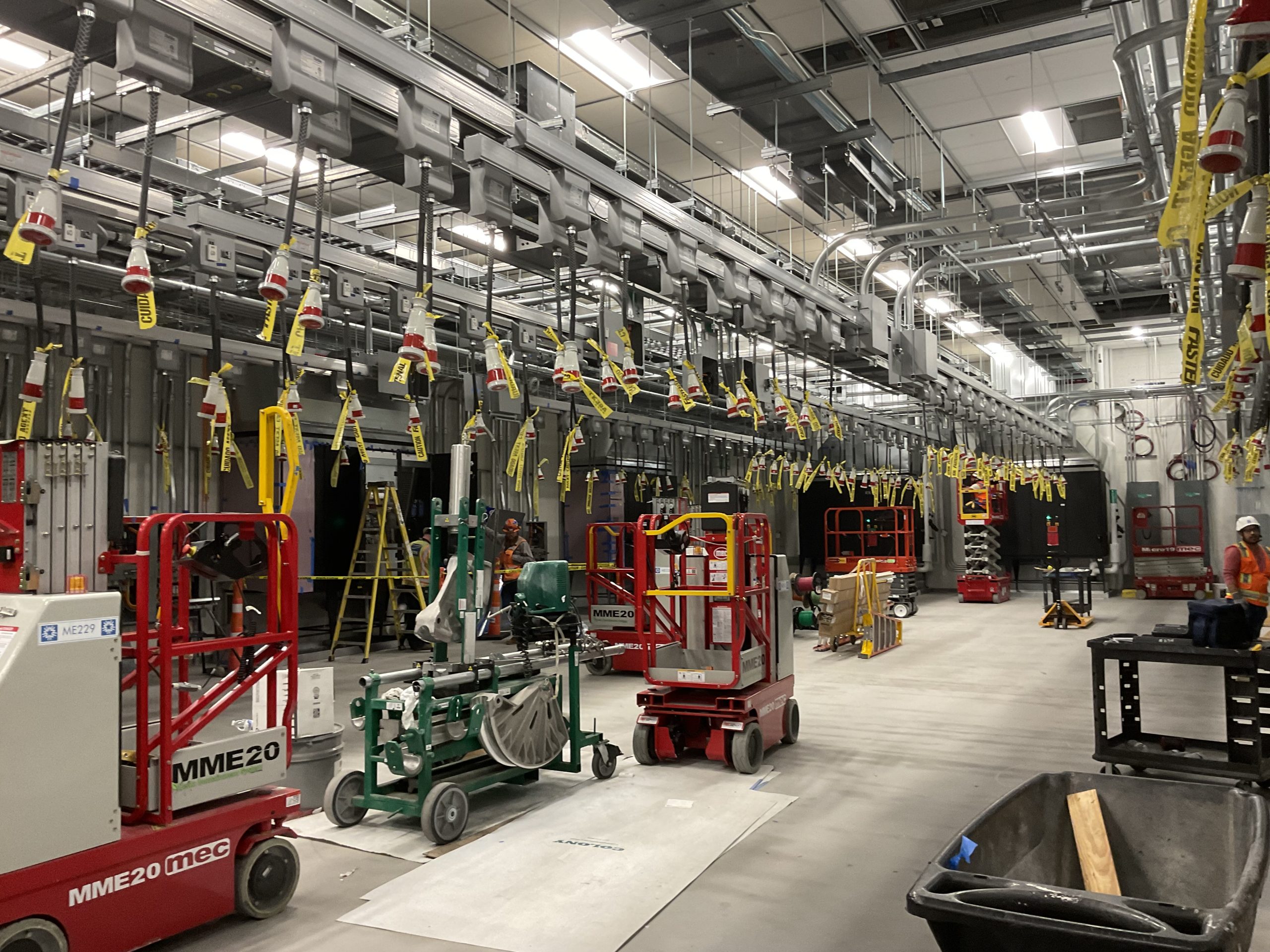
Every infrastructure decision should support continuous operations while anticipating future technology and business needs. Electrical, mechanical, controls, life safety, and power generation systems must work together as an integrated ecosystem that supports continuous operations, mitigates risk, and advances long-term business objectives.
Why Failure Is Not an Option
Recent service disruptions have underscored how dependent modern business, government, healthcare, transportation, communications, and financial systems are on uninterrupted digital infrastructure. Data centers no longer support only back-office technology. They are essential to everyday operations, from cloud applications and payment systems to emergency communications, research computing, manufacturing, and customer-facing platforms.
Industry reporting continues to show that while data center outages may be becoming less frequent overall, the consequences of failure remain significant. Uptime Institute’s 2026 outage analysis found that roughly one in ten recent outages still had serious or severe impacts, with power remaining a leading cause of impactful outages and external dependencies such as grid stability, fiber connectivity, and cloud service reliance playing a growing role.
These incidents also illustrate that failures can stem from many sources, including cooling interruptions, power events, fires, software defects, network failures, and external infrastructure disruptions. These events reinforce a critical point. Mission critical facilities must be designed, commissioned, and operated to anticipate failure and maintain operations.
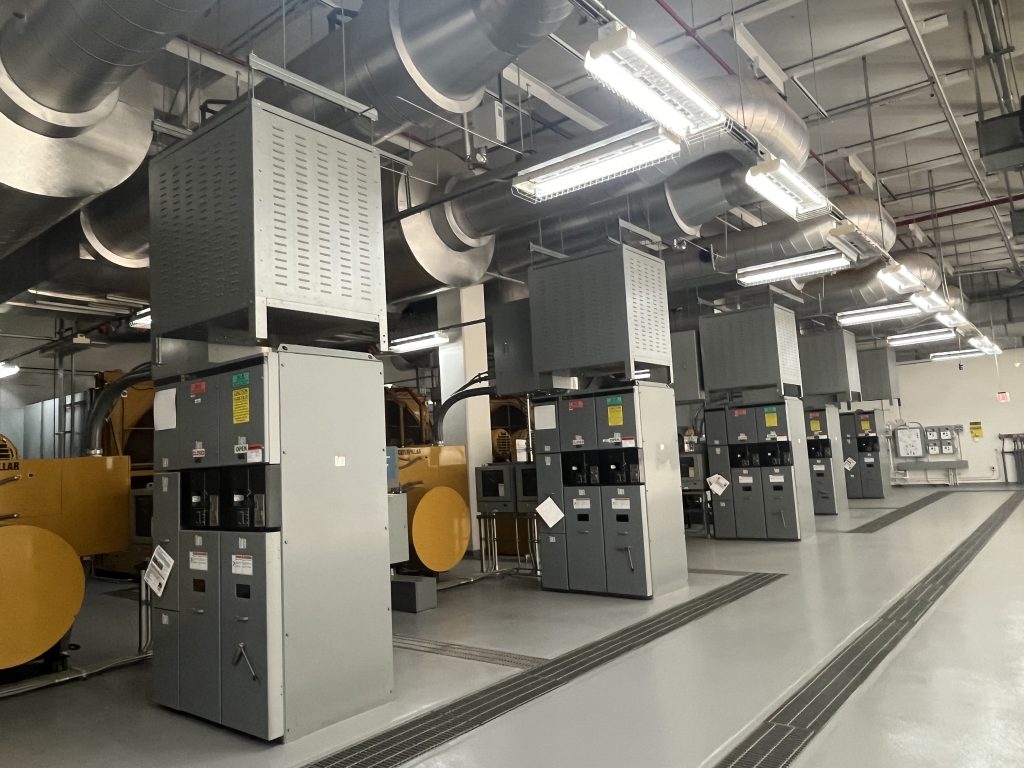
Resilience is not simply about having backup equipment. It requires integrated systems that can detect problems, isolate faults, transfer loads, maintain cooling, preserve life safety functions, and recover predictably under real-world conditions. As digital demand grows and infrastructure becomes more interconnected, the cost of failure is measured not only in downtime, but also in lost productivity, customer disruption, delayed services, reputational impact, and broader business continuity risk.
Building Confidence Through Commissioning
As data centers become more complex, commissioning plays an increasingly essential role in reducing operational risk and verifying system performance.
Commissioning provides an opportunity to confirm that systems perform as intended under both normal operating conditions and real-world failure scenarios. The process helps validate redundancy, fault tolerance, maintainability, and alignment with the Owner’s Project Requirements before service begins.
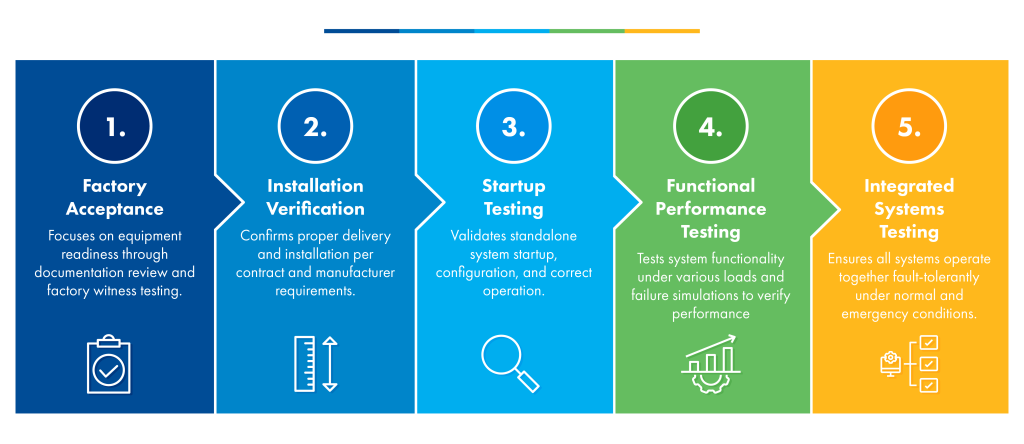
Effective commissioning extends beyond individual components. Data center commissioning often follows five progressive levels that build confidence in the performance, reliability, and operational readiness of mission critical facilities.
Achieving this confidence requires a structured process that begins long before the facility opens. Equipment is tested at the factory, verified after installation, evaluated during startup, and then challenged through a series of increasingly complex performance scenarios. The ultimate goal is simple: ensuring the data center continues operating when demand is high, systems are stressed, and uptime matters most.
Validating Performance Across Every Tier
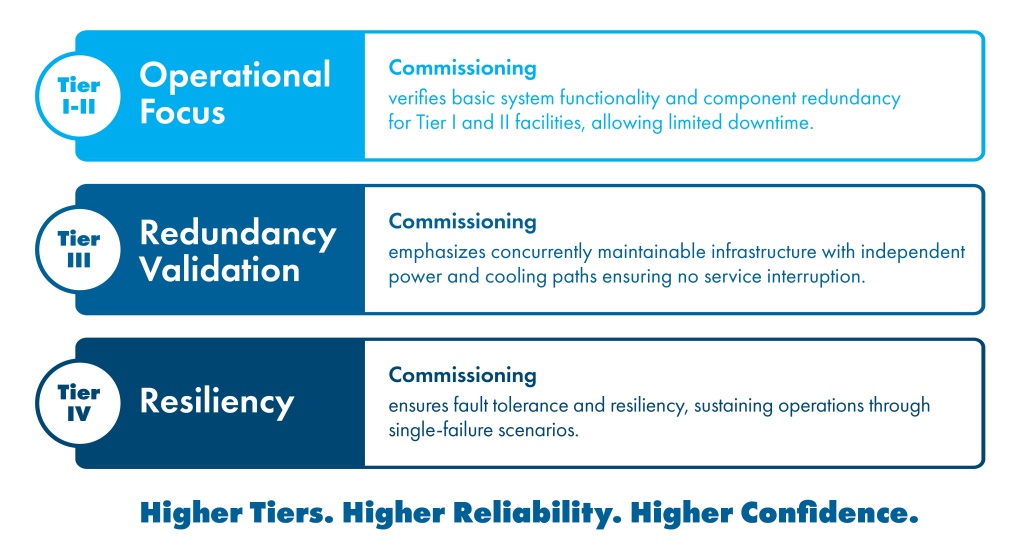
Not all data centers are built to the same standard, and neither are the design and commissioning processes that ensure the required “uptime” is achieved. These facilities are commonly classified into tiers as defined by the Uptime Institute, with each tier representing a different degree of redundancy, maintainability, and fault tolerance. As the tier level increases, so should the intensity of the commissioning process. Tier III and Tier IV facilities represent the industry’s highest levels of resiliency, with configurations commonly associated with annual downtimes of approximately 1.6 hours and 26 minutes, respectively.
Designing for What Comes Next
As demand continues to grow, owners face increasing pressure to balance reliability, sustainability, energy availability, and business continuity. These advanced assets must be designed not only to meet today’s requirements but also to adapt to evolving technologies and future operational demands.
TLC Engineering Solutions helps owners navigate these challenges through multidisciplinary engineering expertise, mission critical experience, and a practical commissioning approach grounded in more than seven decades of engineering practice. TLC’s portfolio includes facilities ranging from 1 MW to more than 100 MW featuring highly redundant infrastructure, on-site microgrids or conventional emergency generation, UPS systems, and advanced air and liquid cooling solutions designed for 24/7 operation.
By aligning infrastructure planning, engineering, and commissioning with long-term operational goals, our team helps deliver operations that are reliable, adaptable, efficient, and prepared for the future of digital infrastructure.