Authors


The business case for electrification begins with reducing wasted energy and improving equipment efficiency. In addition, it can support cleaner operations and help prepare infrastructure for future utility, regulatory, and operational changes. Electrification can help owners address these goals in a coordinated way rather than treating sustainability, cost control, resilience, and long-term planning as separate conversations. That broader value is important because electrification is not only for buildings pursuing aggressive carbon goals. It can also support practical owner concerns such as aging equipment replacement, utility cost management, and reducing on-site combustion. When planned thoughtfully, electrification gives owners a clearer path to modernizing building systems while positioning their facilities for a changing energy landscape.
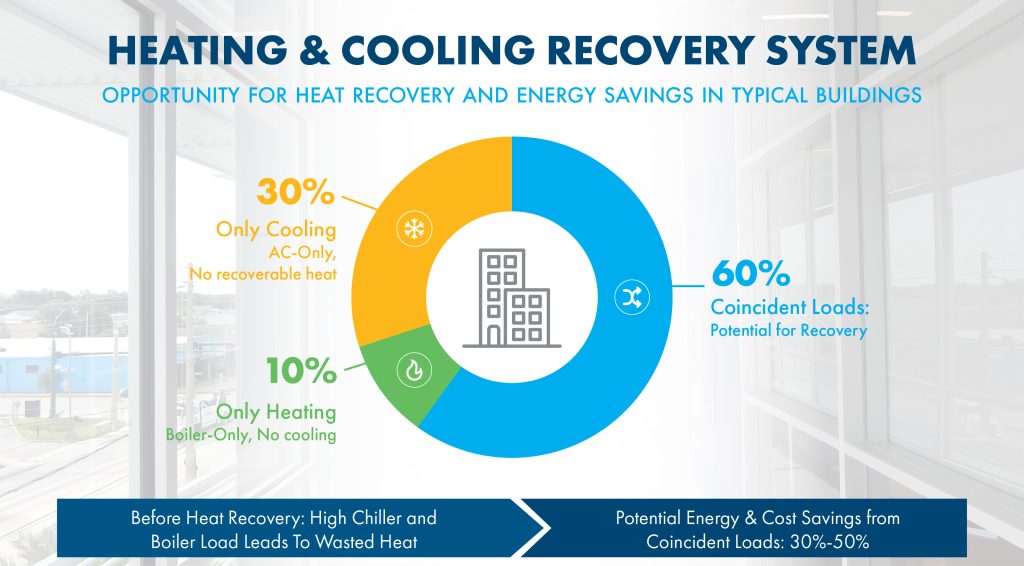
Electrification, at its core, is the replacement of building systems that burn fossil fuels with systems that run on electricity. The engineering challenge is to maximize heat recovery potential in facility operations and serve the remaining heating load with high-efficiency heat pumps. This approach avoids common practices like simultaneous heating and heat rejection through boiler stacks and cooling towers. One process creates heat while another is rejecting excess heat. The intent is to turn previously wasted heat or energy into useful building processes.
A significant share of annual heating energy can come from recovered heat, with supplemental heating reserved for the few coldest hours each year. Optimized heat pump and heat recovery technology allow for maximum efficiency and building performance. Technologies applied in building electrification strategies include heat recovery chillers, heat pump chillers, heat pump water heaters, air-source heat pumps, and thermal energy storage.
The biggest drawback of using heat pumps in cold climates is that their efficiency and capacity drop as ambient temperatures fall. As a result, they provide the least heat when heating demand is greatest. Heat pumps running in heat recovery mode, commonly known as heat recovery chillers, don’t face the same limitations because they rely on heat already generated within the building rather than cold ambient air. It’s always summertime in the core spaces of a building, which means they need cooling year-round. This provides recoverable heat. The new generation of heat pumps are less susceptible to the low ambient temperature performance drop off. There are products on the market that can produce 120 degrees F heating hot water down to -13 degrees F ambient. When heat recovery alone is not enough, ground-source or geothermal heat pumps can provide another effective path for electrifying heating in cold climates, even in building types with limited heat recovery opportunities, because they use the earth as their source of heat.
High-Impact Facilities, Higher-Value Results
Beneficial electrification maximizes heat recovery and technology to provide efficient building comfort throughout the year. Complex facilities with simultaneous heating and cooling demands, such as hospitals, laboratories, commercial buildings, and industrial buildings with simultaneous cooling and process requirements experience the most benefit by coupling heating and cooling generation rather than relying on separate systems for each. This approach is especially powerful in warm, humid climates. In locations where true heating weather represents only a small portion of the year, heating energy is often dominated by reheat rather than envelope losses. In these conditions, a heat recovery chiller can become the primary heating source, producing heating hot water while also supporting cooling loads.
The ability to capture and reuse energy that would otherwise be wasted is especially significant in healthcare. According to ASHE, healthcare buildings represent a small share of commercial floor space but account for a much larger share of commercial building energy use. In healthcare environments, where reliability is non-negotiable and energy demands are constant, electrification can move from a broad facility strategy to a high- impact infrastructure opportunity. Hospitals and other inpatient facilities are the largest energy users within the healthcare sector because they operate continuously and require simultaneous cooling, dehumidification, reheating, ventilation, domestic hot water, sterilization support, and process loads.
Overlapping requirements make healthcare facilities especially well suited for heat recovery systems because energy removed from one part of the building can often be redirected elsewhere in the facility. Rather than treating cooling and heating as separate loads, an electrified plant can use heat recovery chillers, heat pump technologies, and advanced controls to capture rejected heat and convert it into useful hot water for reheat, domestic water preheating, or other building demands.
This strategy can reduce on-site combustion, lower wasted energy, and improve overall plant efficiency while still maintaining the redundancy and operational reliability that healthcare owners require. For hospitals, full or phased electrification is therefore not simply a sustainability measure; it can be a practical infrastructure strategy that supports resilience, long-term cost management, and a cleaner path for future growth.
Electrification in Practice: the Ronald Reagan Building
For existing buildings, limited electrical service capacity can be one of the biggest barriers to electrification. There must be electrical load capacity for shifting heating from fossil fuels to electricity. To free up electrical capacity, load reduction energy conservation measures are applied, such as lighting replacements, new windows, and increased insulation. Then electric heat pumps can be employed for heating using their increased efficiency, known as coefficient of performance or COP, to provide multiple units of heat for every kW, making the additional electrical capacity go further towards full electrification. Thermal energy storage can extend the use of heat pumps for heating by producing and storing hot water during the day for nighttime use, while also reducing peak electrical demand and lowering the operating cost of electrification.
For the Ronald Reagan Building and International Trade Center in Washington, DC, TLC’s design enabled the largest building in the city to transition away from the local district steam system. By pairing a heat recovery chiller with simultaneous building loads, the system can efficiently produce heating hot water and chilled water at the same time to support building operations. The design also incorporates air-to-water heat pumps, heat pump domestic water heaters, and electric boilers for the remaining heating load.
Lowering Operating Costs Over Time
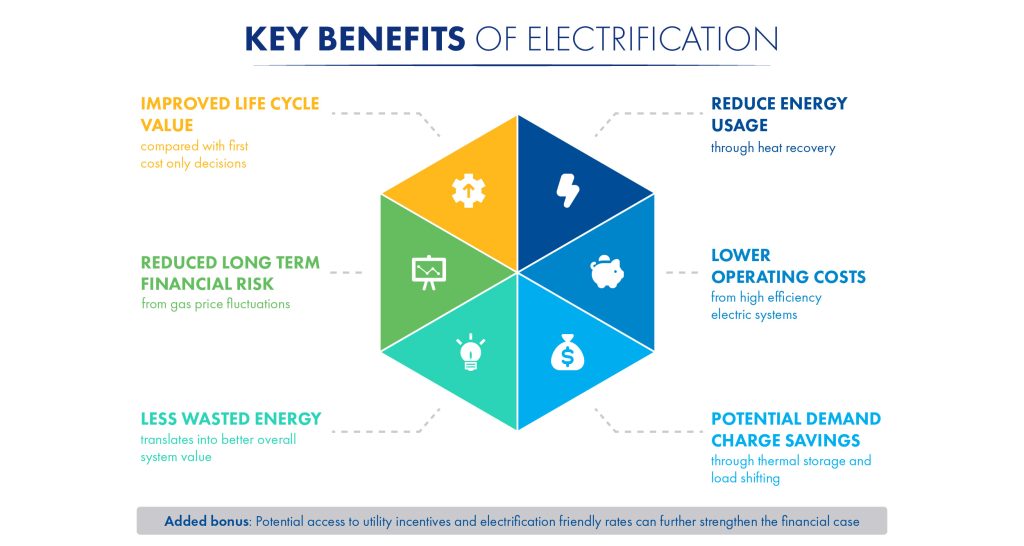
The benefits are not only environmental. Electrification can also improve long-term financial performance when paired with targeted energy modeling, rate review, and utility strategy. Comparative energy modeling and life cycle cost analysis can help right-size the equipment, while plant optimization can evaluate the marginal cost of heat from heat recovery, electrification strategies, and backup systems to select the lowest cost source while maintaining reliability. Heat recovery integration can also support meaningful energy savings over time.
Efficient electrification strategies can also reduce wasted energy while easing stress on the grid when thoughtfully deployed. High-performance operational systems can support space and water heating more efficiently than conventional resistance heating, creating opportunities for bill savings, lower peak demand, and reduced carbon pollution in applicable settings.
Rate structures are also evolving to support electrification. In many regions, efficient electrification strategies can add demand during periods when grid capacity may be underused compared with summer peaks. For large facilities, this reinforces the value of aligning electrification decisions with utility rate strategy, incentive review, and long-term energy planning.
When Priorities Align
The most compelling benefit of electrification may be that it aligns so many owner priorities at once. It can reduce site emissions, recover energy that would otherwise be wasted, improve efficiency, support lower operating costs, create a cleaner long-term carbon trajectory, and position facilities for a changing energy landscape. It also strengthens the carbon and community health story by reducing or eliminating onsite combustion. As the electric grid continues to decarbonize, an all-electric, heat recovery-based plant can become cleaner over time while reducing combustion related infrastructure concerns and exposure to gas price volatility. For hospitals and mission critical facilities, that value extends to resilience and reliability. Electrification does not mean fragility. An electrified plant can be designed with hospital grade redundancy, grid independent operation, passive survivability, and thermal storage. Thermal energy storage can shift plant demand to off-peak periods, flatten afternoon demand peaks, provide hours of conditioning during outages, and support lower demand charges.
In climates with year-round cooling and reheat needs, the opportunity is even stronger because the building’s own rejected heat becomes a valuable resource. For hospitals and other complex facilities, electrification is not simply a technology choice. It is a future-focused infrastructure strategy. When designed around heat recovery, resilience, smart controls, and long-term flexibility, it helps owners create facilities that are cleaner, more efficient, more adaptable, and better prepared for what comes next.
Move Forward with Confidence
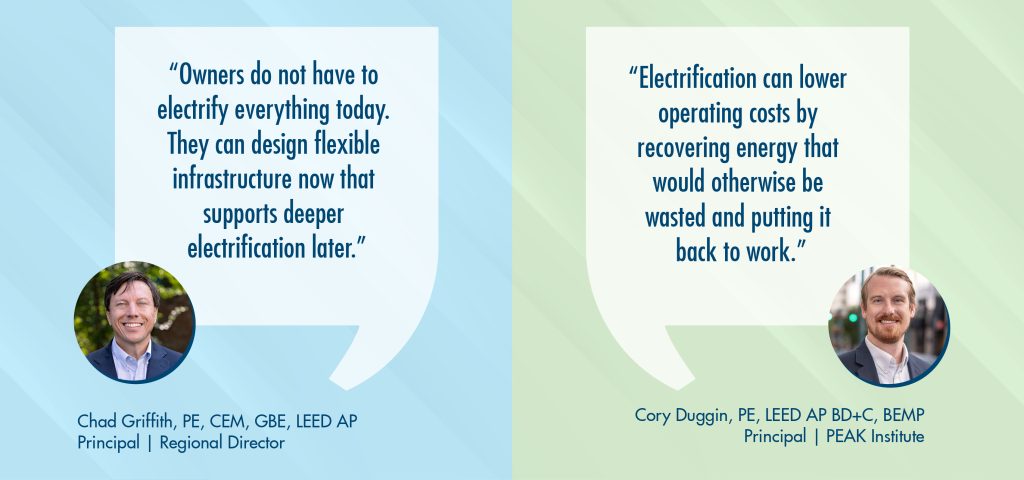
A facility does not have to solve every future energy question on day one. Modular growth, expandable plant architecture, pre-provisioned headers and switchgear, future tie-ins, and advanced controls can allow deeper electrification over time. With a future-ready approach, infrastructure can be planned for additional heat recovery capacity and operational equipment as a campus expands.
Flexibility matters while the market continues to transition. The technology exists, but adoption is often shaped by replacement cycles, default system choices, and owner priorities. Benefits such as comfort, air quality, health, resilience, and lower bills can resonate as strongly as climate goals. For facility owners, electrification should be understood not only as a carbon strategy, but as an operational, financial, health, and resilience strategy.
As owners evaluate what electrification could mean for their facilities, TLC brings the technical expertise and multidisciplinary perspective needed to turn opportunity into a practical, future-ready strategy. From energy modeling and central plant design to heat recovery, resilience planning, and long-term infrastructure flexibility, TLC helps clients understand the benefits, weigh the options, and move forward with confidence.
