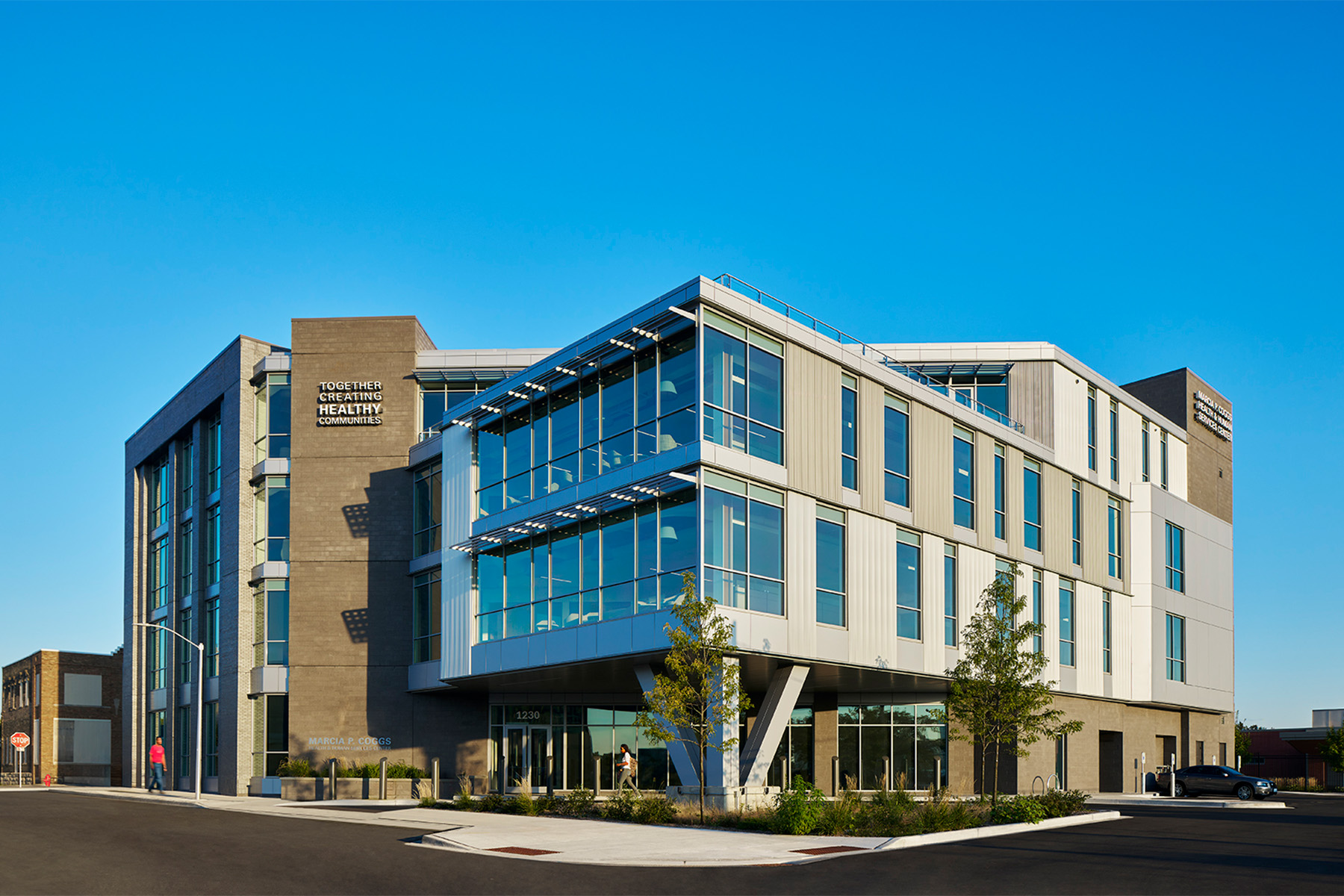




Milwaukee County Marcia P. Coggs Health and Human Services Center
Overview
The new Marcia P. Coggs Health and Human Services Center honors Marcia P. Coggs, the first African American woman elected to the state assembly, a lifelong member of the Health and Human Services Committee, and a passionate advocate for social change. Located just north of the existing facility, the new building serves as the headquarters for the county’s Department of Health and Human Services. It includes training spaces, offices, community engagement areas, a small warehouse, and the new Friedens Food Pantry.
This is the first new county building to be constructed in or near downtown Milwaukee in over 20 years, with funding made possible through the American Rescue Plan Act (ARPA). The building has also received Designed for Energy Star certification, a key milestone on the path to achieving full Energy Star recognition.
Features
In alignment with Milwaukee County’s Climate Action 2050 Plan— which aims to reduce county carbon emissions to zero by 2050— the facility was designed with sustainability in mind. The design team implemented a high-performance building envelope, guided by recommendations from the ASHRAE Achieving Zero Energy Advanced Energy Design Guide for Small to Medium Office Buildings. They evaluated various design options to determine the most cost-effective approach, factoring in both energy efficiency and initial construction costs.
Three HVAC systems were assessed for their first costs, life cycle costs, and greenhouse gas (GHG) emissions. Given the high first costs and the elevated electricity rates from a section of the grid that has not yet fully phased out coal, the decision was made to select a system with a lower initial cost and reduced operating expenses. This system incorporates fossil fuel boilers but is designed with future space and electrical capacity to transition to an all-electric system once the grid reaches parity with on-site combustion. This phased approach allows the county to stay on track with its goal of achieving zero GHG emissions by 2050, while avoiding a rise in emissions and costs from day one.
As an immediate step toward reducing GHG emissions, photovoltaic panels were installed on part of the building’s roof and on a canopy over the neighboring parking lot. These solar systems were sized to generate enough electricity annually to make the facility net-zero for site energy once the HVAC system is fully converted to all-electric.
